 By
Excessive machine vibration isn’t just an irritating noise issue. It can loosen fasteners, accelerate bearing wear, damage connected components, and increase maintenance costs. For manufacturers across Milwaukee, WI, where industrial machinery operates for extended production cycles, controlling vibration is essential for maintaining equipment reliability.
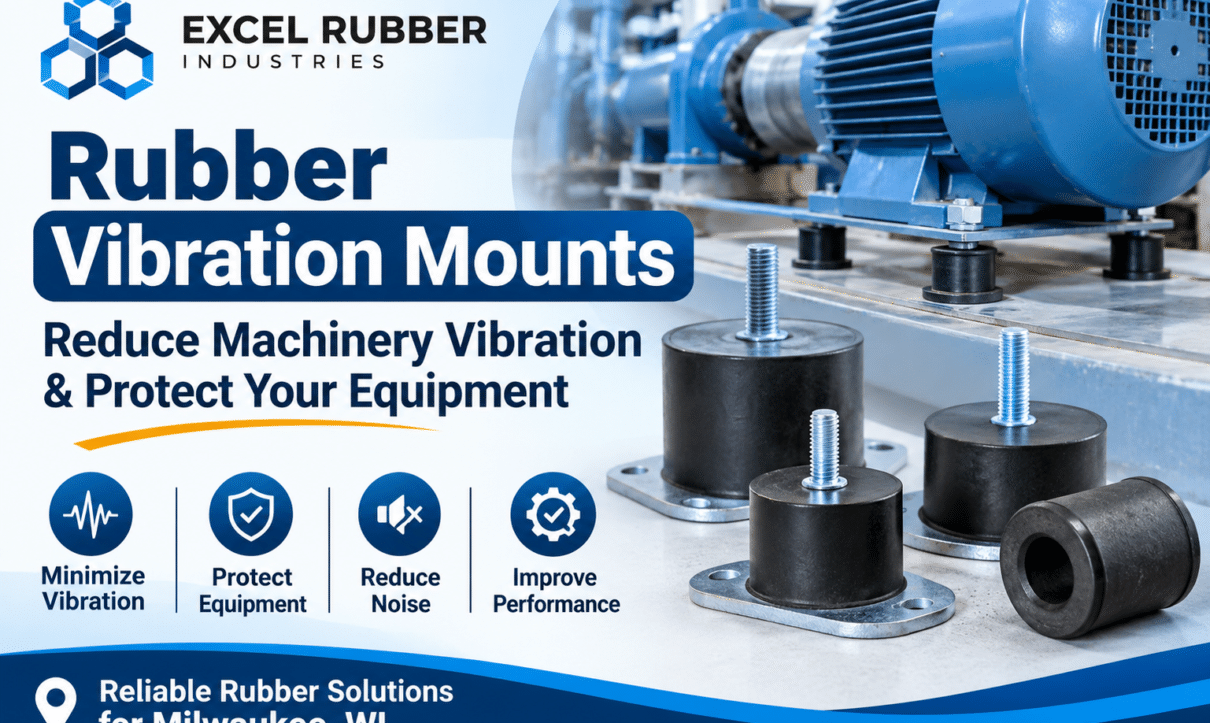
One practical solution is installing properly selected rubber vibration mounts. These components absorb mechanical energy, reduce vibration transmission, and help protect equipment from unnecessary stress.
However, choosing the wrong mount can make the problem worse. Load capacity, operating frequency, rubber hardness, and environmental conditions all influence performance. This guide explains how to identify vibration problems, select suitable mounts, and improve industrial equipment stability.
Table of Contents
- Why Industrial Machinery Experiences Excessive Vibration
- How Rubber Vibration Mounts Reduce Machine Vibration
- Common Applications in Milwaukee Industries
- How to Choose the Right Vibration Mount
- Rubber Vibration Mounts vs. Metal Mounting
- Expert Tips and Common Mistakes
- Frequently Asked Questions
Why Does Industrial Machinery Experience Excessive Vibration?
Industrial equipment generates vibration through rotating, reciprocating, and moving components. When these forces aren’t properly isolated, they transfer into machine frames, floors, and surrounding structures.
Common causes include:
- Unbalanced rotating components: Motors, fans, and pumps can generate repetitive vibrations.
- Misalignment: Incorrectly aligned shafts and couplings create additional mechanical stress.
- Worn components: Damaged bearings and loose connections increase operational movement.
- Poor mounting systems: Rigid connections can transfer vibration directly into supporting structures.
- Resonance: When operating frequency approaches a system’s natural frequency, vibration can become amplified.
For example, a manufacturing facility operating an industrial air compressor may experience excessive floor vibration and noise. Installing correctly specified vibration isolators can reduce transmitted vibration and help protect surrounding equipment.
How Do Rubber Vibration Mounts Reduce Machine Vibration?
Rubber vibration mounts create a flexible barrier between machinery and its supporting structure. Their elastomeric construction allows controlled deformation under load, helping absorb shock and reduce vibration transmission.
Unlike rigid metal connections, industrial rubber vibration mounts provide cushioning while supporting equipment.
Key benefits include:
- Reduced structure-borne noise.
- Improved equipment stability.
- Lower mechanical stress on connected components.
- Reduced shock transmission.
- Better protection against premature wear.
However, performance depends on selecting the correct stiffness and load capacity. A mount that’s too hard may transmit excessive vibration, while one that’s too soft may allow unwanted movement.
Common Applications in Milwaukee Industries
Manufacturers, OEMs, and industrial facilities around Milwaukee use vibration-control components across several applications.
| Equipment | Vibration-Control Benefit |
|---|---|
| Industrial motors | Reduces transmitted operating vibration |
| Air compressors | Helps absorb mechanical shock |
| Pumps | Minimizes vibration transfer to supporting structures |
| Generators | Helps reduce operational noise and movement |
| HVAC equipment | Improves vibration isolation |
| Automotive machinery | Protects connected components from repeated mechanical stress |
Rubber anti-vibration mounts are particularly useful when equipment operates continuously or shares a supporting structure with other machinery.
How to Choose the Right Rubber Vibration Mount
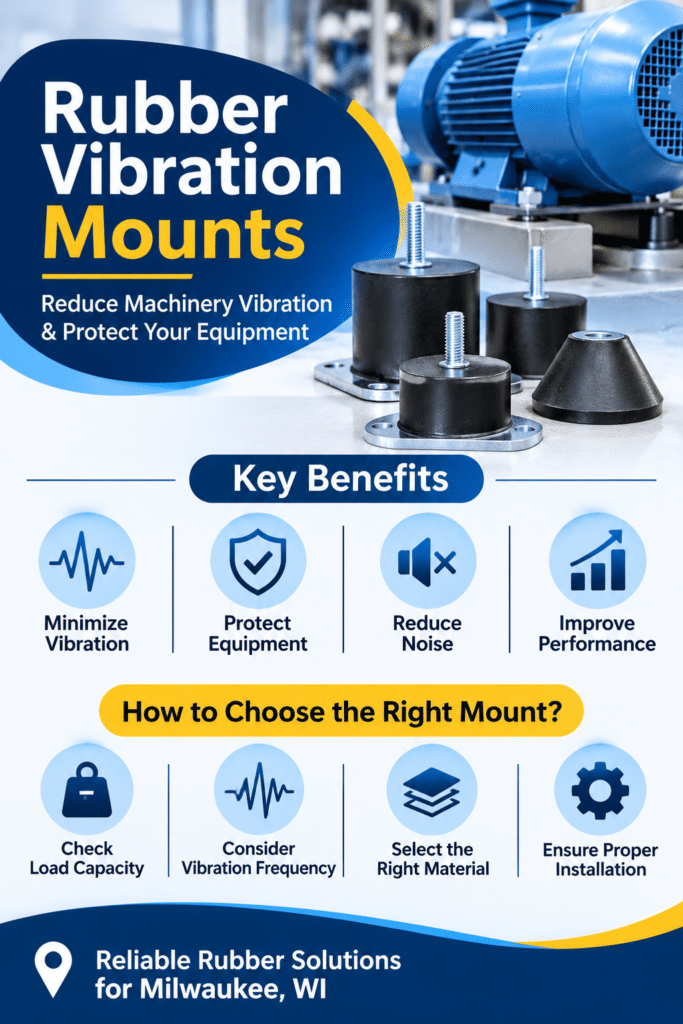
Selecting a suitable mount requires more than matching dimensions. Consider these five factors before purchasing.
1. Calculate the Load Per Mount
Determine the equipment’s total operating weight and how it’s distributed across mounting points.
For example, a 400-pound machine supported by four equally loaded mounts places approximately 100 pounds on each mount. Actual corner loads may differ depending on the machine’s center of gravity.
2. Check Operating Frequency
Identify the machine’s operating speed and vibration frequency. The mount’s natural frequency should be sufficiently below the disturbing frequency to achieve effective isolation.
3. Select the Correct Rubber Hardness
Rubber hardness, measured in Shore A, affects stiffness and deflection. Softer compounds generally allow greater deflection, while harder compounds provide firmer support.
4. Consider Environmental Exposure
Evaluate exposure to:
- Industrial oils and lubricants.
- Heat and temperature fluctuations.
- Moisture and outdoor conditions.
- Chemicals and cleaning agents.
Select a compatible rubber compound based on actual operating conditions.
5. Check Mounting Dimensions
Verify bolt patterns, mounting height, available clearance, and attachment requirements before ordering.
Rubber Vibration Mounts vs. Metal Mounting
| Feature | Rubber Mounts | Rigid Metal Mounting |
|---|---|---|
| Vibration isolation | Provides cushioning | Transfers more vibration |
| Shock absorption | Good when properly specified | Limited |
| Noise control | Helps reduce transmitted noise | Can increase structure-borne noise |
| Flexibility | Allows controlled movement | Minimal flexibility |
| Maintenance | Requires periodic inspection | Requires connection inspection |
Rubber vibration isolators are often preferable when vibration reduction and shock absorption are priorities.
Expert Tips and Common Mistakes
Expert Tips
- Inspect mounts regularly for cracking, hardening, and permanent deformation.
- Check whether mounting bolts remain properly secured.
- Verify load distribution before selecting replacement mounts.
- Investigate misalignment and worn bearings instead of relying on mounts alone.
- Consider custom dimensions when standard mounts don’t fit the application.
Common Mistakes to Avoid
- Choosing mounts based only on price.
- Ignoring operating temperature and chemical exposure.
- Using identical mounts despite uneven load distribution.
- Selecting rubber hardness without considering equipment weight.
- Expecting mounts to correct mechanical imbalance or misalignment.
Frequently Asked Questions
What are rubber vibration mounts used for?
Rubber vibration mounts absorb shock and reduce vibration transmission between machinery and supporting structures. They’re commonly used in motors, compressors, pumps, generators, and industrial equipment.
How do I know when vibration mounts need replacement?
Look for visible cracks, rubber hardening, excessive compression, separation from bonded metal, or increased equipment vibration. Investigate the underlying cause before replacing them.
Are industrial rubber vibration mounts suitable for heavy machinery?
Yes, provided their load capacity, geometry, compound, and deflection characteristics are correctly matched to the equipment.
Which rubber material is best for vibration isolation?
Natural rubber, EPDM, neoprene, and NBR may suit different applications. The right choice depends on temperature, oil exposure, environmental conditions, and required mechanical performance.
Where can Milwaukee manufacturers source rubber vibration mounts?
Milwaukee-area manufacturers can explore custom rubber component solutions from Excel Rubber Industries Inc. based on their equipment requirements, drawings, and application specifications.
Conclusion
Uncontrolled machinery vibration can increase maintenance expenses, reduce equipment reliability, and disrupt production. Properly selected rubber vibration mounts help address these challenges by absorbing shock and reducing vibration transmission.
For manufacturers and OEMs in Milwaukee, WI, choosing the right material, load capacity, and mounting configuration is essential for long-term performance.
Looking for Reliable Rubber Vibration Mounts?
Explore Excel Rubber’s rubber vibration mounts for industrial vibration-control requirements.
Contact Excel Rubber Industries Inc. to discuss your project requirements and request a quote.
- Phone: +1 (734) 887-6030
- Email: info@excelrubber.com