 By
Excessive machinery vibration isn’t just annoying. It can loosen fasteners, damage equipment components, increase maintenance costs, and affect production efficiency. For manufacturers operating in Milwaukee, WI, where industrial machinery, automotive equipment, pumps, compressors, and production systems are essential, effective vibration control matters.
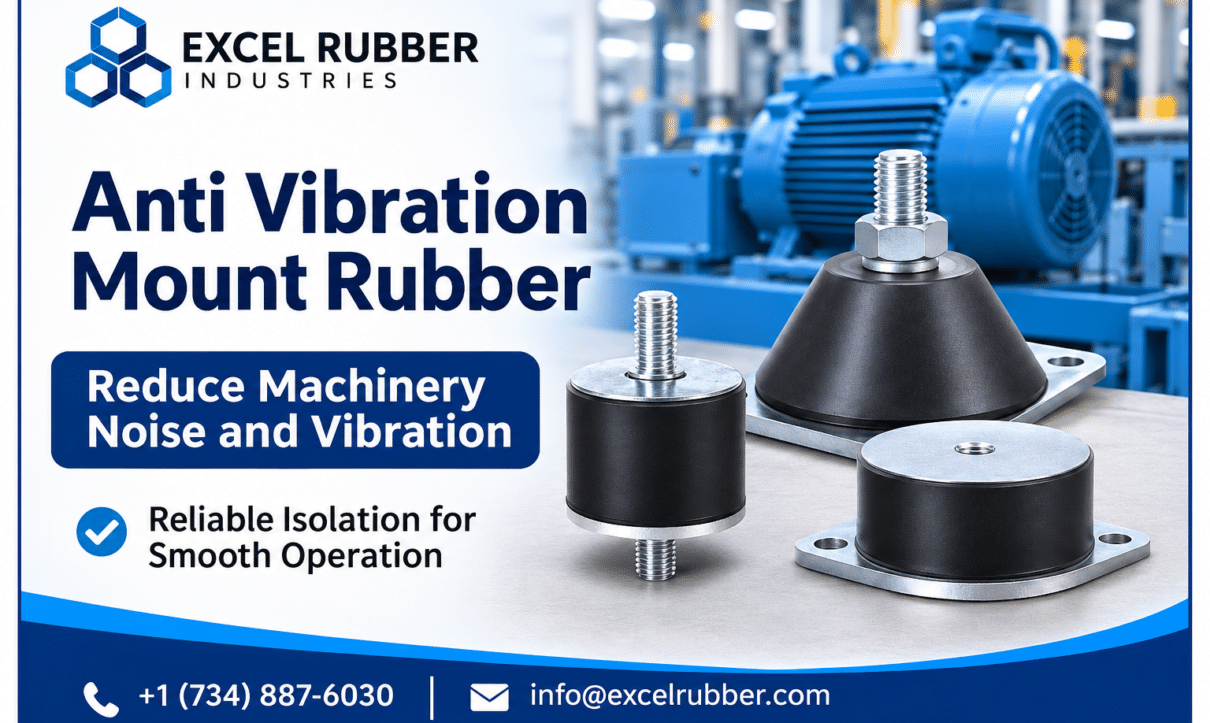
One practical solution is an anti vibration mount rubber designed to absorb mechanical energy and reduce vibration transmission between equipment and its supporting structure.
However, choosing the right mount involves more than selecting a rubber component that fits. Load capacity, operating frequency, rubber hardness, temperature, and installation conditions all influence performance.
In this guide, we’ll explain how rubber vibration mounts work, explore common types, and help you select the right solution for your machinery.
Table of Contents
- What Is an Anti-Vibration Rubber Mount?
- How Do Rubber Vibration Mounts Work?
- Types of Anti-Vibration Mounts
- Common Industrial Applications
- How Do I Choose a Rubber Vibration Mount?
- Expert Tips and Common Mistakes
- Frequently Asked Questions
1. What Is an Anti-Vibration Rubber Mount?
An anti-vibration rubber mount is a resilient component installed between machinery and its mounting surface to minimize vibration, shock, and noise transmission.
These mounts typically combine specially formulated rubber with metal components, depending on their design and application.
Unlike rigid mounting arrangements, rubber isolators provide flexibility that helps prevent mechanical vibration from spreading through floors, frames, and connected equipment.
For example, a manufacturing facility operating an industrial air compressor may experience excessive floor vibration. Installing appropriately selected rubber isolation mounts can help reduce transmitted vibration and improve operating conditions.
2. How Do Rubber Vibration Mounts Work?
Rubber vibration mounts work through elasticity and damping.
When machinery operates, it generates mechanical forces. The rubber element deforms under these forces, absorbs some vibration energy, and reduces the amount transmitted to the supporting structure.
Their performance depends on several factors:
- Rubber hardness: Influences stiffness and load-bearing behavior.
- Static deflection: Determines how much the mount compresses under equipment weight.
- Operating frequency: Affects vibration isolation effectiveness.
- Load distribution: Helps maintain consistent performance across mounting points.
A properly selected mount helps prevent excessive movement while reducing vibration transmission.
3. Types of Anti-Vibration Mounts
Different machinery requires different mounting configurations.
| Mount Type | Common Application |
|---|---|
| Cylindrical rubber mounts | Motors and compressors |
| Conical vibration isolation mounts | Engines and heavy machinery |
| Sandwich mounts | Industrial equipment and machine bases |
| Stud-type rubber mounts | Compact equipment installations |
| Heavy-duty rubber isolators | Construction and industrial machinery |
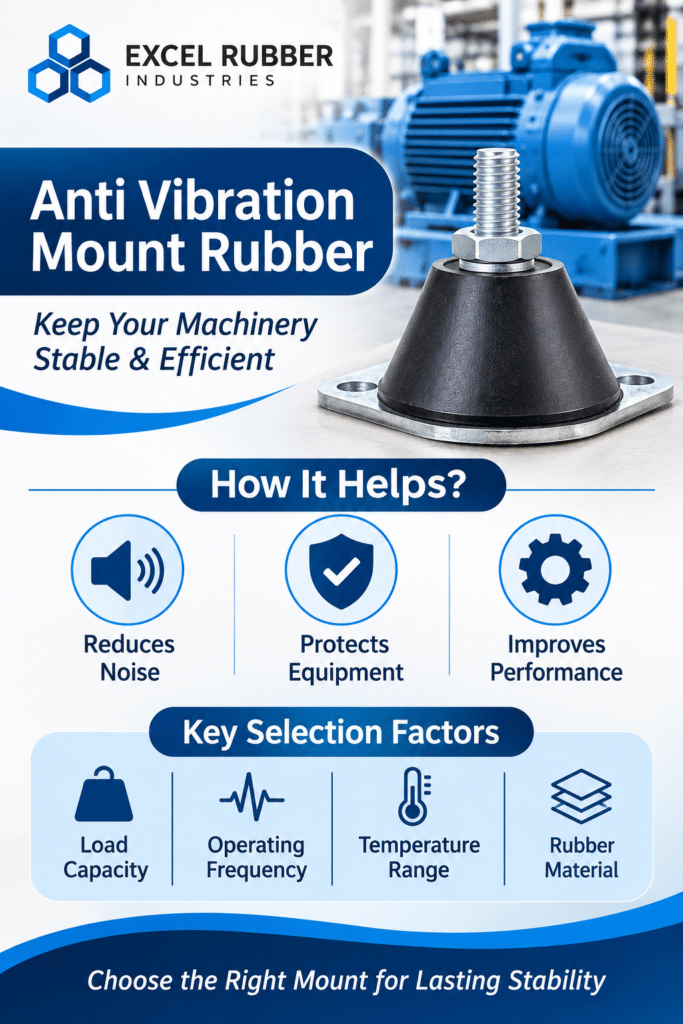
Conical vibration isolation mounts are particularly useful when equipment requires stability under multidirectional forces. Their shape and rubber configuration help accommodate different loading conditions.
For heavier equipment, the mount must be selected according to actual load requirements rather than appearance or dimensions alone.
4. Common Industrial Applications
Anti-vibration mounts for plant machinery are used across several industries.
Common applications include:
- Manufacturing: CNC machines, presses, production equipment, and automated systems.
- Automotive: Engines, transmissions, and vehicle assemblies.
- HVAC: Industrial fans, compressors, and ventilation systems.
- Food processing: Pumps, mixers, and processing equipment.
- Construction: Generators, drilling equipment, and heavy machinery.
- Marine: Engine installations and equipment isolation.
For Milwaukee manufacturers, selecting suitable anti vibration rubbers can help reduce vibration-related maintenance issues and support more consistent equipment operation.
5. How Do I Choose a Rubber Vibration Mount?
Choosing the correct mount requires understanding the machine’s operating conditions.
Use this practical load and frequency checklist before requesting a quotation.
Load and Frequency Selection Checklist
Step 1: Calculate the load per mount
Divide the total supported equipment weight by the number of mounting points.
Example:
- Equipment weight: 800 lbs
- Number of mounts: 4
- Load per mount: 200 lbs
Remember to account for uneven weight distribution and the machine’s center of gravity.
Step 2: Identify operating frequency
Record the machinery’s operating speed in RPM.
Convert RPM into frequency:
Frequency (Hz) = RPM ÷ 60
For example, a machine operating at 1,200 RPM produces a fundamental rotational frequency of 20 Hz.
Step 3: Consider natural frequency
The mount and supported machinery form a spring-mass system.
For effective isolation, the system’s natural frequency should be sufficiently below the disturbing frequency. Otherwise, resonance may amplify vibration instead of reducing it.
Step 4: Check rubber material and hardness
Consider:
- Operating temperature
- Oil and chemical exposure
- Environmental conditions
- Required flexibility
- Expected service life
Step 5: Confirm installation requirements
Check mounting dimensions, bolt configurations, available clearance, and whether the mount experiences compression, shear, or dynamic loading.
For complex machinery, consult an experienced manufacturer or vibration specialist before finalizing the design.
6. Expert Tips and Common Mistakes
Expert Tips
- Measure actual equipment weight instead of relying on estimated specifications.
- Evaluate vibration at different operating speeds.
- Consider environmental exposure when selecting rubber compounds.
- Ensure mounting points are positioned appropriately around the equipment’s center of gravity.
- Request application-specific recommendations for unusual loading conditions.
Common Mistakes to Avoid
- Selecting mounts based only on physical dimensions.
- Ignoring unequal load distribution.
- Choosing rubber that’s too stiff for the application.
- Overlooking temperature and chemical exposure.
- Installing mounts without checking alignment and fastening requirements.
A properly engineered mounting arrangement can make a significant difference in long-term equipment performance.
Frequently Asked Questions
What is the purpose of an anti-vibration rubber mount?
It helps isolate machinery vibrations, reduce transmitted noise, absorb shock, and protect connected equipment and supporting structures.
Which rubber is best for vibration isolation?
The appropriate compound depends on load, temperature, frequency, and environmental exposure. Natural rubber, neoprene, EPDM, and other elastomers may be suitable depending on application requirements.
Are conical vibration isolation mounts suitable for heavy machinery?
They can be suitable for machinery experiencing multidirectional forces, provided their load capacity, stiffness, and operating characteristics match the application.
How often should rubber vibration mounts be replaced?
Replacement depends on operating conditions, rubber aging, loading, and visible deterioration. Inspect mounts regularly for cracking, deformation, separation, and excessive movement.
Where can Milwaukee manufacturers source custom anti-vibration mounts?
Manufacturers can work with specialized rubber product suppliers such as Excel Rubber Industries Inc. to discuss application-specific rubber vibration mount requirements and custom manufacturing possibilities.
Conclusion
Selecting the right anti vibration mount rubber is essential for controlling machinery vibration, reducing transmitted noise, and protecting industrial equipment.
For manufacturers in Milwaukee Rubber Manufacturer , WI, understanding load capacity, operating frequency, rubber hardness, and installation conditions helps avoid costly selection mistakes.
The right solution isn’t necessarily the hardest or largest mount. It’s the one engineered to match the machinery’s actual operating requirements.
Get Custom Rubber Vibration Mount Solutions from Excel Rubber
Excel Rubber Industries Inc. offers rubber vibration mounts and custom molded rubber solutions for industrial, automotive, construction, and other applications.
Whether you need standard configurations or custom-designed components, discuss your application requirements with the team.
Request a quote: Rubber Vibration Mounts
Explore more: Molded Rubber Products
Contact: +1 (734) 887-6030
Email: info@excelrubber.com