 By
By The rubber band sitting in your desk drawer and the elastic component retaining a wire harness on an engine block at 200°F share the same name. Almost nothing else about them is the same. One is a commodity. The other is an engineered part with a compound, dimensional tolerance, tensile rating, and a service environment it has to survive. Getting that distinction wrong in an industrial context means failure, downtime, or a safety event that traces back to a purchasing decision that felt minor at the time.
This is exactly the problem that manufacturers like Excel Rubber Industries Inc. exist to solve. When an off-the-shelf rubber band can’t be specified to meet real application requirements, you need a supplier who can engineer the part, not just ship a box of them. This article walks through the full specification process: material selection, performance specs, real industrial applications, and the framework for deciding when a standard band suffices versus when a custom component is the right call.
Why Rubber Band Material Is the First Decision, Not an Afterthought
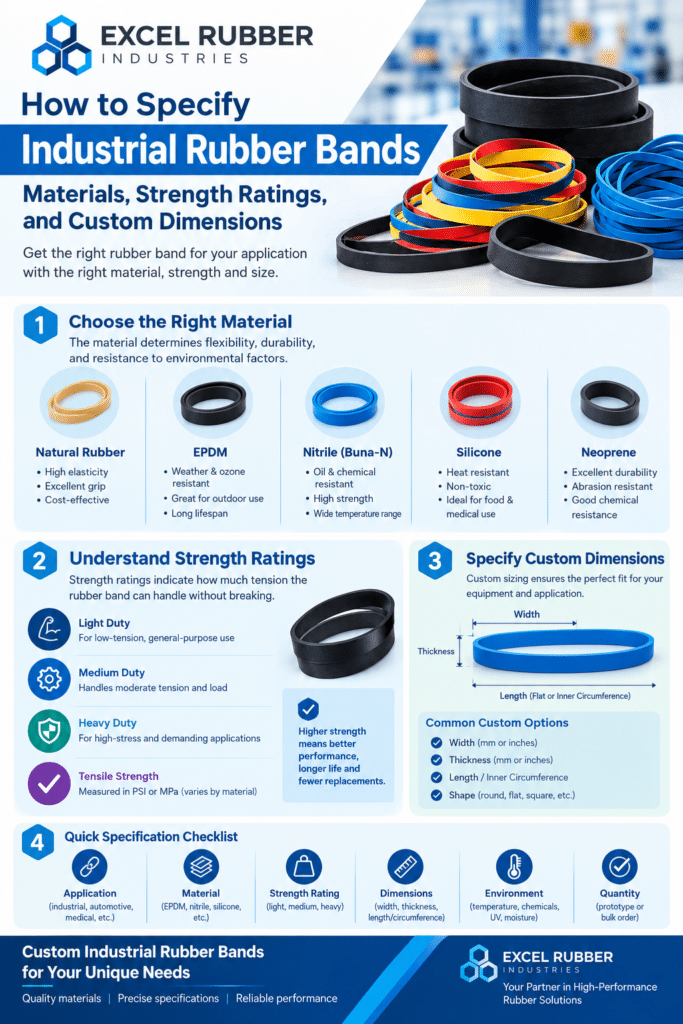
A band’s ability to stretch, recover, resist heat, tolerate chemicals, and hold its properties over time all trace back to compound selection. Material isn’t a box to check after you’ve picked a size. It drives every other performance characteristic.
Natural Rubber: Still the Benchmark for Stretch and Snap-Back
Natural rubber remains the elasticity standard. Tensile strength typically runs 16 to 30 MPa, with elongation at break reaching 500 to 800 percent. Those numbers explain why it dominates commodity office and packaging applications. The honest limitations are real, though: UV degradation, ozone sensitivity, poor oil resistance, and latex allergy risk make it a poor choice the moment the environment introduces any of those factors.
Synthetic Compounds and What They Solve
Each engineered alternative addresses a specific failure mode. EPDM handles weathering, ozone, water, and steam exposure, with a continuous service range from roughly minus 58°F to 302°F. Nitrile resists petroleum oils and fuels, making it the right call for automotive and machine assembly environments. Silicone extends the temperature window dramatically, continuous-service grades typically perform from minus 60°F to roughly 392, 446°F depending on compound formulation, with short-term peak tolerances varying further by grade, and its biocompatibility makes it well-suited for medical applications. Viton, a fluorocarbon elastomer, leads the group on chemical and high-temperature resistance, which is why aerospace and harsh process environments specify it despite its lower elongation values.
How Environment Drives Compound Selection
The selection logic is straightforward once you define the environment first. A band exposed to hydraulic fluid on a machine assembly needs nitrile. A medical packaging application requires silicone or a documented non-latex compound with biocompatibility data. An outdoor agricultural or HVAC application calls for EPDM, where weathering resistance pays real dividends over time. The instinct to reach for “standard” should be the last step, not the first. Define the environment, then select the compound that survives it.
Rubber Band Sizing and Strength Ratings
Understanding how elastic bands are specified lets engineers communicate clearly with suppliers and avoid the mismatch between what gets ordered and what the application actually demands. Three dimensional values and two performance properties cover most industrial specifications.
Sizing: Lay-Flat Length, Width, and Wall Thickness
Rubber bands are specified with three dimensions. Lay-flat length is the measurement from one folded end to the other when the band is unstretched and flat. Width is measured perpendicular to the length, across the rubber strip. Wall thickness is the material’s cross-sectional depth. Familiar numbered office sizes like #16, #32, and #64 define standard combinations of these dimensions in inches, but industrial specifications work in precise millimeter tolerances, a small deviation can affect fit, load distribution, or sealing function, with tolerance classes defined by standards such as ISO 3302-1 for extrusion and molding applications. Worth noting: a band’s relaxed circumference is approximately twice its lay-flat length, which matters when calculating how a band will fit around a bundle or component.
Tensile Strength and Elongation Ratings
These two properties are related but distinct. Tensile strength is a material property, reported in MPa, describing how much stress the rubber can carry before it fails. Breaking force is a part property, reported in pounds-force, describing how much load the finished band withstands before it breaks. Both matter when specifying a band. Doubling the cross-sectional area of a band approximately doubles its breaking force, giving you a practical rule of thumb when sizing up from a known baseline. Elongation at break is a separate but equally important spec; it defines how far the band stretches before it fails, and working strain should be set well below that threshold in any load-bearing application.
Temperature and Chemical Resistance
These two specs are the most frequently ignored in commodity purchasing and the most consequential in industrial use. Natural rubber handles moderate elevated temperatures adequately, consult supplier data or ASTM formulation guidance for exact continuous-service limits, as performance depends on compound and loading conditions. Silicone remains functional well above 400°F depending on grade. Viton handles aggressive chemical environments that would destroy most other compounds. A band operating near its thermal limit ages dramatically faster under cyclical loading, so the service temperature ceiling is a design constraint, not just a material curiosity.
Where Elastic Bands Do Real Industrial Work
Industrial rubber bands appear across sectors in ways that most procurement checklists undercount. They’re not just bundling supplies; they’re retention and sealing components with specific performance requirements.
Automotive and Aerospace Applications
Wire harness bundling is one of the most common uses in automotive manufacturing. It requires bands with consistent tension, abrasion resistance, and controlled outgassing per customer specification to avoid contaminating sensors or connectors. Bands also serve vibration retention functions on assemblies subject to engine or chassis vibration, where a compliant restraint prevents lateral drift, connector loading, and insulation wear. Aerospace applications add another layer: lot-level traceability documentation and specific compound certifications are required for regulated applications, requirements that commodity bands cannot support. Retail commodity bands typically lack the lot numbers, material certifications, and batch test reports that aerospace and medical suppliers must provide.
Medical, HVAC, and Electronics Contexts
In medical settings, elastic bands bundle catheters, secure sterile packaging, and appear in device assemblies where non-latex requirements aren’t optional. HVAC applications benefit from EPDM’s weathering resistance for sealing and hold-down functions in outdoor or semi-exposed equipment. Electronics manufacturing introduces static-dissipative and low-outgassing compound requirements to protect sensitive components. Each of these contexts maps directly to a specific material and dimensional specification from the earlier sections.
Why the Wrong Band Creates Real Cost
A band that degrades under heat can allow a wire harness to chafe against a moving part. A latex band in a medical setting can trigger an allergy event with serious liability implications. A band with insufficient tensile strength under sustained load creeps and fails without warning. The cost of the wrong rubber band is almost never the band itself. It’s the downtime, the warranty claim, or the incident report that follows.
When to Go Custom Instead of Off-the-Shelf
Standard bands are designed for general use cases. When your application has specific requirements that general-purpose bands aren’t specified to meet, a custom part is the correct engineering decision.
Signs That a Standard Band Is the Wrong Tool
The indicators are clear when you know what to look for:
- Application temperature falls outside the common range for natural rubber
- Chemical exposure the commodity compound can’t handle
- Dimensional requirements that fall between standard sizes
- Load requirements that need documented tensile ratings with a safety factor
- Regulatory or traceability requirements that commodity packaging doesn’t support
If any of these apply, a standard band is a workaround, not a solution.
What a Custom Rubber Band Specification Looks Like
A complete custom rubber band specification includes the following elements:
- Compound type
- Lay-flat length with tolerance
- Width with tolerance
- Wall thickness
- Surface finish requirements
- Durometer
- Elongation at break target
- Any test or certification requirements (AS9100, IATF 16949, ISO 13485, or ISO 10993 as applicable)
Manufacturing method also matters. Extrusion produces consistent circular profiles economically at volume, typically holding bilateral tolerances around plus or minus 0.15 to 0.70 mm depending on the dimension and tolerance class. Compression molding suits thicker or more complex cross-sections, achieving tighter tolerances on discrete molded features. Die-cutting from sheet stock handles flat-profile or gasket-style loops. Each method affects cost, lead time, and dimensional precision differently, so the specification and the process should be selected together.
How Excel Rubber Industries Inc. Approaches Custom Band Design
Excel Rubber Industries Inc. works from the compound outward. The process starts by matching the material to the application environment, then defining the dimensional specification with actual engineering tolerances, then selecting the manufacturing process that achieves those tolerances at production volume. For regulated industries, Excel Rubber provides testing and traceability documentation tied to lot numbers, including certificates of conformity and batch test reports. Because Excel Rubber handles extrusion, molding, and fabricated rubber parts under one roof, the specification-to-production cycle can be meaningfully shorter than working across separate compound suppliers, fabricators, and testing houses, with change control and communication contained in a single relationship. The full process runs in one place, which matters when lead time and specification integrity are part of the requirement.
Storing Bands Correctly to Preserve the Properties You Specified
A band specified and manufactured correctly still degrades prematurely if stored improperly, wasting the engineering investment before the part reaches service.
The Storage Conditions That Matter
Store rubber bands in a cool, dry, dark environment, ideally between 50 and 77°F, in a sealed opaque container. UV exposure, ozone, heat, and moisture are the four primary aging accelerants. Keep bands relaxed rather than pre-stretched or tightly coiled; sustained deformation under storage causes compression set and permanent shape change. Keep them away from ozone-producing equipment like motors, generators, and fluorescent ballasts, which accelerate degradation even without direct contact.
How to Recognize Degradation Before It Causes a Failure
Surface cracking, tackiness, loss of snap-back, discoloration, and permanent deformation under light load are all signs that a band has reached the end of its service life. Replace bands showing any of these signs before they fail in service, not after. For critical applications, implement a rotation schedule based on the compound’s rated shelf life and document it. A band that fails during service because it was stored past its rated shelf life is a specification and process failure, not just a material failure.
The Case for Treating Elastic Bands as Engineered Components
A rubber band is only a commodity when the application is truly general-purpose. The moment temperature, chemical exposure, dimensional precision, or regulatory requirements enter the picture, material and spec decisions become engineering decisions. The selection logic is consistent: choose compound by environment, specify dimensions to actual need, verify tensile and elongation ratings against the load, and store to manufacturer guidelines.
For applications where standard bands can’t be specified to meet those requirements, working with a manufacturer like Excel Rubber Industries Inc. to design and produce a custom elastic component is the right path. It’s not a premium option reserved for extreme applications. It’s the correct engineering call when performance has to be documented and repeatable. Contact Excel Rubber Industries Inc. to walk through your application requirements. Their team compound-matches, manufactures, and certifies to the spec your application actually needs.
The right rubber band, properly specified, is a reliable part. An underspecified one is a liability waiting to surface.